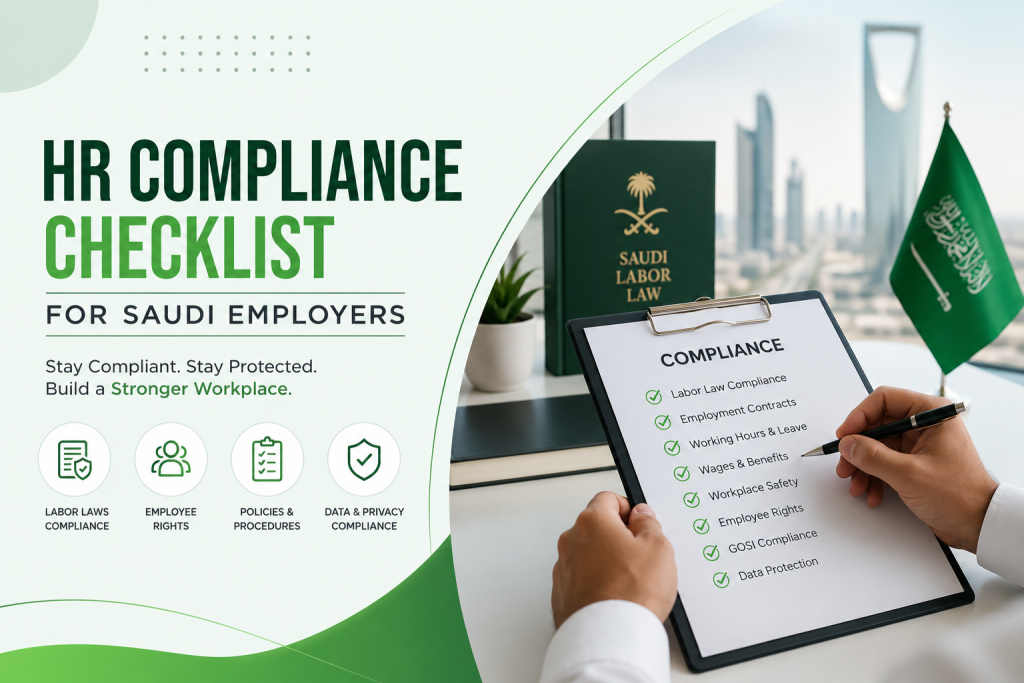
A structured and comprehensive HR compliance checklist for Saudi employers has become one of the most important resources to keep everything organized and according to the latest and current regulations and simultaneously mitigate legal and financial risks.
With each update and reform in the labour laws, employers are expected to maintain accurate records, follow proper HR processes, and meet ongoing reporting obligations. Even the smallest administrative mistake, such as an expired employment contract, incomplete employee file, or inaccurate payroll record, can lead to penalties, workplace disputes, delayed government processes, and unnecessary operational costs and disruptions.
For many businesses, compliance is no longer a task completed once a year but is an ongoing responsibility which touches every stage of the employee lifecycle, from recruitment and onboarding to payroll, performance management, and offboarding. HR compliance involves issuing employment contracts, processing salaries, managing employee records, maintaining accurate documentation, following workplace policies, tracking attendance, correctly handling leaves, and keeping up with the latest Saudi HR regulations from the Ministry of Human Resources and Social Development (MHRSD) and the General Organization for Social Insurance (GOSI).
The challenge however lies in with HR teams already balancing recruitment, employee relations, payroll administration, performance management, and workforce planning. Adding frequent regulatory updates to an already full workload increases the risk of mistakes which is why so many companies have started relying on experienced HR partners to manage compliance more effectively for them. Alongside reducing administrative work, professional service providers offer businesses assistance with keeping accurate documentation, improving internal processes, and quickly responding to changing legal requirements.
A lot of businesses also choose to work with us at Connect Resources Saudi to simplify and strengthen their day-to-day HR operations through our reliable HR outsourcing services, compliance support, payroll assistance, and workforce management solutions. Instead of reacting to compliance issues after they have occurred, businesses can instead build diligent systems to reduce risk from the start.
In this guide, we share a practical HR compliance checklist for Saudi employers. We also discuss the documentation, processes, and operational responsibilities every employer should review regularly for conducting compliance reviews or improving existing HR systems.

What is HR Compliance?
HR compliance refers to the process of making certain that an organization’s HR procedures, workplace policies, employee records, and employment practices follow the relevant labour laws and government regulations. It covers much more than payroll or employment contracts and extends throughout the entire employee lifecycle, from hiring through exit.
In simpler terms, compliance means doing the right HR activities, maintaining the correct documentation, and following established legal and operational procedures every day.
Many employers mistakenly believe compliance begins and ends with hiring employees and paying salaries on time when Saudi HR compliance actually covers dozens of ongoing responsibilities. For employers, HR compliance for Saudi employers extends across multiple operational areas, including:
- Maintaining complete employee records.
- Managing compliant employment contracts.
- Accurately recording attendance .
- Tracking leave balances.
- Maintaining performance documentation.
- Keeping payroll records.
- Protecting employee information.
- Following internal HR policies.
- Managing employee exits properly.
- Meeting reporting obligations with relevant government authorities.
- Implementing workplace policies.
Every HR activity creates documentation that might later be reviewed during audits, employee disputes, inspections, or internal investigations. Missing paperwork can become as problematic as violating a regulatory requirement.
Strong compliance protects employers and employees as it minimizes disputes, supports fair workplace practices and helps businesses maintain operational continuity.
Poor compliance, on the other hand, can result in the following financial, legal, and reputational risks:
- Financial penalties.
- Regulatory investigations.
- Delayed business operations.
- Employee complaints.
- Damaged employer reputation.
Key Takeaway:
HR compliance is an ongoing operational responsibility and not a one-time legal task. Businesses should regularly review internal HR processes to reflect the changing Saudi HR regulations.
Businesses looking to simplify HR compliance can benefit from professional HR outsourcing services offered by Connect Resources Saudi.
Why HR compliance matters?
Strong HR compliance protects you as the employer and your workforce by creating consistency across HR operations and reducing any avoidable legal and financial risks.
Organizations with well-managed compliance systems experience:
- Fewer employee disputes.
- Better documentation during audits.
- More consistent HR decisions.
- Lower risk of financial penalties.
- Greater employee trust.
- Improved operational efficiency.
- Faster response to government requests.
Instead of spending valuable time correcting preventable mistakes, your HR teams get enough room to focus on attracting talent, improving employee engagement, and supporting your business’s growth.
Businesses using our professional HR compliance services Saudi Arabia usually find it easier to maintain documentation standards and keep up with the changing requirements.
Key Takeaway:
HR compliance is an ongoing operational responsibility which includes documentation, employee records, workplace policies, payroll records, attendance management, performance tracking, and employee exits. Consistent compliance reduces business risk and improves HR efficiency.

Why is HR Compliance Critical in Saudi Arabia?
HR compliance is so important in Saudi Arabia because employers here are responsible for maintaining accurate records, following labour regulations, protecting employee rights, and making sure that workplace documentation remains current throughout employment. Not doing so can result in penalties, operational delays, employee disputes, or reputational damage.
For example:
- An expired employment contract can create legal uncertainty.
- Missing employee documentation can delay inspections.
- Incorrect leave calculations trigger employee disputes.
- Poor record keeping makes HR audits significantly more difficult.
Saudi Arabia has invested heavily in modernizing its employment environment. Regulatory reforms continue to improve transparency, employee protection, and workplace standards. As expectations increase, employers are expected to maintain stronger HR governance and better record keeping than ever before.
Saudi employers must consistently manage:
- Employee protection
- Employment documentation
- Payroll obligations
- Attendance records
- Contract management
- Government reporting
- Internal HR policies
Instead of reacting to compliance issues after they occur, successful businesses integrate it into their everyday HR operations. They implement structured internal processes to support ongoing employment compliance in Saudi Arabia.
Key Takeaway:
Compliance involves building reliable HR operations to reduce risk and improve employee trust and business stability.
If your organization currently lacks dedicated HR expertise, partnering with Connect Resources Saudi can overcome compliance risks and improve operational efficiency for your business
1. Employee protection remains a priority:
Modern workplaces rely on clear documentation which protects employees and employers. Proper records demonstrates that employees have received:
- Valid employment contracts.
- Appropriate leave entitlements.
- Accurate salary payments.
- Performance feedback.
- Workplace policies.
- Fair disciplinary procedures.
When documentation is missing, disagreements become much harder to resolve. For example, an employer might verbally approve annual leave but fail to record it properly. Months later, disagreements over remaining leave balances can create unnecessary conflict that could have been simply avoided through accurate HR documentation.
2. Labour regulations continue to go through changes:
Employment regulations change over time to support economic development, workforce modernization, and employee welfare. That’s why HR departments have to regularly review internal processes to make sure they are following the current expectations issued by authorities of the Ministry of Human Resources and Social Development (MHRSD) and the General Organization for Social Insurance (GOSI). This is one of the major reasons as to why so many organizations perform scheduled compliance reviews instead of waiting until issues arise.
Connect Resources Saudi works closely with businesses to monitor operational HR compliance so employers can focus on running their business and decrease administrative pressure.
3. Documentation is often the biggest compliance weakness:
One of the most common findings during HR reviews is incomplete documentation. Businesses can have excellent intentions but struggle with maintaining organized employee files across hundreds of workers. Each missing document increases compliance risk over time. These documentation gaps usually include:
- Missing offer letters
- Expired employment contracts.
- Outdated employee contact information.
- Missing qualification records.
- Unsigned HR policy acknowledgements.
- Incomplete probation documentation.
- Missing performance reviews.
For growing companies that hire frequently, keeping documentation current becomes increasingly difficult without standardized HR procedures.

4. Payroll compliance depends on accurate HR records:
Payroll accuracy starts long before salaries are processed. Incorrect employee information often leads to payroll problems such as:
- Incorrect salary calculations.
- Wrong leave deductions.
- Overtime disputes.
- Incorrect allowances.
- Delayed salary approvals.
Accurate employee records help payroll teams process salaries with greater confidence and decrease potential correction requests.
Organizations that combine strong documentation practices with reliable payroll outsourcing services significantly overcome payroll-related compliance risks.
5. Government reporting requires reliable information:
Many employer duties depend on maintaining accurate employee information throughout the year. If your HR records are incomplete or inconsistent, government reporting becomes more complicated. That’s why compliant businesses already have organized records available with reliable HR systems which make it easier to:
- Verify employee information.
- Update employment records.
- Maintain historical documentation.
- Respond to audits.
- Produce required reports efficiently.
6. Contract management reduces unnecessary disputes:
Employment contracts should never become forgotten documents after onboarding. Allowing contracts to expire without timely action can create unavoidable compliance issues. Routine contract reviews help employers identify upcoming deadlines before they become urgent. Your HR teams should routinely monitor the following:
- Contract start dates.
- Expiration dates.
- Amendments.
- Renewals.
- Position changes.
- Compensation updates.
For example: Consider there is a growing technology company that’s hiring 40 employees over six months. Their HR team heavily focuses on recruitment because vacancies need to be quickly filled. But they are inconsistent with completing documentation. As a result, some of their employees receive updated contracts while others do not. Moreover, they are missing emergency contact forms for several employees, and qualification certificates have never been added to personnel files.
Months later, during an internal HR audit, dozens of missing documents must be collected retroactively. Their managers have to spend weeks tracking down paperwork that could have been completed during onboarding.
A structured HR checklist for employers would have prevented this situation altogether by standardizing documentation from day one.
Businesses experiencing instantaneous hiring can partner with Connect Resources Saudi for our recruitment services and ongoing compliance support so your operational growth does not come at the expense of regulatory compliance.
Compliance Area |
Employee documentation |
Employment contracts |
Payroll records |
Attendance records |
HR policies |
Performance documentation |
Compliance reviews |
Why It Matters |
Supports audits, disputes, and regulatory reviews |
Clarifies rights and employer obligations |
Improves salary accuracy and compliance |
Supports working hour compliance |
Creates consistency across the workforce |
Reduces disputes over disciplinary decisions |
Identify risks before they become violations |

Complete HR Compliance Checklist:
A practical Saudi labor law checklist should cover every stage of the employee lifecycle.
Employee Documentation:
Since employee records are the foundation of HR compliance requirements in Saudi Arabia, every file should be accurate, complete, and regularly updated.
Employment Contracts:
Your business should maintain signed employment contracts that clearly outline:
- Job title
- Compensation
- Working hours
- Benefits
- Probation terms
- Notice periods
National ID or Iqama:
As an employer, you should keep current identification records for every employee.
Passports:
Wherever applicable, your HR teams should securely retain expat employees’ passport information according to company policy and relevant local labour laws.
Offer Letters:
You should also store accepted offer letters to maintain a documented hiring history.
Emergency Contacts:
It is important to keep updated emergency contact information for every employee.
Employee Files:
Maintain centralized employee files containing:
- Personal information
- Employment history
- Performance records
- Leave records
- Payroll documentation
- Compliance documents
Qualifications:
Retain educational certificates relevant to the employee’s position.
Certifications:
Maintain professional licenses and certifications.
Employee Documentation Checklist | Status |
Signed employment contract | ✔ |
National ID/Iqama copy | ✔ |
Passport details | ✔ |
Offer letter | ✔ |
Emergency contacts | ✔ |
Qualifications | ✔ |
Certifications | ✔ |
Updated employee file | ✔ |
Hiring Compliance:
With hiring compliance in Saudi Arabia, you can make sure that your company’s recruitment processes are consistent, documented, and legally compliant before you begin hiring your teams.
Every hiring process should include:
Legal Recruitment:
Ensure recruitment follows applicable employment regulations and internal hiring procedures.
For further reading, you can also check out our recruitment guide on this topic.
Background Verification:
Conduct appropriate background and qualification verification.
Offer Approvals:
Document internal approvals before extending employment offers.
Contract Signing:
Make sure the contracts are signed before employment commences.
Probation Documentation:
Maintain written probation terms and performance expectations.
Key Takeaway:
A structured HR checklist for employers begins before your employee’s first working day.
Payroll Compliance:
Our payroll compliance checklist Saudi Arabia focuses on maintaining accurate salary records, approvals, and employee payment documentation. As an employer, you should maintain:
- Salary accuracy
- Overtime calculations
- Leave balances
- Payroll approvals
- Salary payment records
- Compliance with Wage Protection System (WPS) reporting
Your payroll records should be accurate, auditable, and supported by appropriate approvals.
Attendance Records:
Accurate attendance documentation supports payroll and compliance which is why you should maintain records for:
- Working hours
- Shift schedules
- Annual leave
- Sick leave
- Unpaid leave
- Absence documentation
- Remote work attendance
- Approved overtime
Modern HR systems significantly reduce manual errors and improve reporting accuracy.
Leave Management:
Poor leave management can become one of the most common reasons for employee disputes. Leave administration should be transparent and consistently documented with the following aspect being tracked:
- Annual leave
- Sick leave
- Emergency leave
- Maternity leave
- Leave approvals
- End-of-service leave balances
Performance Documentation:
Performance records provide important evidence during promotions, disciplinary actions, and employee development. It requires you to document performance reviews, promotion records, warnings, and improvement plans. Consistent documentation supports fair workplace decisions and reduces potential future disputes.
Warnings:
Any written disciplinary notices issued to an employee should be well-documented.
Performance Reviews:
Performance reviews consist of regular documented evaluations.
Improvement Plans:
If there are any improvement plans for an employee, the documents should be there outlining the performance improvement objectives and follow-up meetings.
Promotion Records:
If there have been salary adjustments and promotion approvals, it should be included in the documentation.
Employee Exit Compliance:
Employee compliance Saudi Arabia continues until the employment relationship officially ends. Every employee exit should include:
- Notice period documentation with recorded resignation or termination notices
- Clearance process with complete departmental clearance requirements
- End-of-Service Benefits (EOSB) with accurate calculation and document final entitlements
- Final payroll to verify if the final salary calculations are properly approved
- Asset return paperwork for collecting company equipment and document returns
- Experience Certificates to issue it employees whenever it’s required
Exit Compliance Checklist | Completed |
Notice documentation | ✔ |
Clearance completed | ✔ |
EOSB documented | ✔ |
Final payroll approved | ✔ |
Company assets returned | ✔ |
Experience certificate issued | ✔ |
HR Policies:
Strong HR policies create consistency across the organization. So every employer should have documented policies covering:
- Code of conduct for expected workplace behaviour
- Anti-harassment policy with outlined procedures for preventing and reporting workplace harassment
- Leave policy with eligibility and approval procedures clearly mentioned
- Attendance policy for working hours and attendance expectations
- Remote work policy consisting of guidelines for your hybrid and remote employees
- Data privacy policy which covers how employee information is confidentially handled
Well-documented policies support consistent decision-making across departments. You can also speak with a compliance expert at Connect Resources Saudi to assess if your HR documentation meets the current business needs.
Most Common HR Compliance Mistakes:
Compliance issues usually stem from routine administrative oversights instead of intentional violations. With regular internal reviews, you can identify major issues before they become too costly. Some of the most common mistakes include missing employee files, expired contracts, improper documentation, payroll errors, incomplete onboarding, missing HR policies, no compliance audits, and little to no proper record keeping.
Missing Employee Files:
Incomplete records make audits more difficult and increase compliance risks.
Expired Contracts:
Not monitoring contract renewals creates unnecessary legal uncertainty for your business.
Improper Documentation:
Undocumented approvals, leave requests, or disciplinary actions weaken HR processes.
Payroll Mistakes:
Incorrect salary records or overtime calculations lead to employee complaints.
Incomplete Onboarding:
Missing documentation during onboarding creates compliance gaps from the start.
Missing HR Policies:
Without written policies, managers might end up applying inconsistent workplace practices.
No Compliance Audits:
Many businesses only review compliance after issues arise.
Poor Record Keeping:
Disorganized records increase administrative workload and delay regulatory inspections.
Key Takeaway:
An annual HR compliance audit checklist should become part of every organization’s operational planning.
How HR Outsourcing Improves Compliance?
Managing compliance internally can become challenging, particularly for growing businesses with limited HR resources. HR outsourcing helps businesses be consistently compliant by providing experienced HR professionals, standardized processes, regular audits, and ongoing regulatory support.
Professional HR compliance services Saudi Arabia include:
- Dedicated HR specialists
- Documentation management
- Internal compliance audits
- Employment record maintenance
- Policy development
- Regulatory monitoring
- Automated HR workflows
- Ongoing advisory support
So instead of allocating valuable management time to administrative tasks, your business’s leadership teams can focus on strategic business priorities. At Connect Resources Saudi, our team works closely with businesses to establish practical compliance processes that mitigate risk and make sure your company’s operations continue without disruption.
Book a consultation with Connect Resources Saudi for a personalized HR compliance assessment.
How Connect Resources Helps Businesses Stay HR Compliant?
Saudi HR compliance requires continuous attention instead of occasional reviews. Connect Resources Saudi provides practical and end-to-end support to businesses for managing their day-to-day HR responsibilities. Our offered solutions include:
- HR outsourcing services that manage ongoing HR administration and compliance for you
- Payroll outsourcing services that improve payroll accuracy and documentation
- Recruitment services to support compliant hiring practices
- Employer of Record (EOR) services for organizations expanding into Saudi Arabia
- Compliance monitoring
- Employee onboarding documentation
- Employee record management
- Labour law support
- HR advisory services
Rather than reacting to compliance issues after they occur, Connect Resources Saudi helps businesses establish diligent processes to lessen administrative pressure and improve operational consistency.
Be it supporting SMEs, multinational companies, or foreign investors entering the Saudi market, our focus remains the same: helping employers stay compliant as they concentrate on their business growth.
Why Businesses Choose Connect Resources?
A large number of organizations entering Saudi Arabia underestimate how much time ongoing HR administration requires. Regulations change, documentation grows, and internal teams can become overwhelmed by manual processes.
Businesses here in KSA choose Connect Resources Saudi because we offer them the following:
- Extensive experience supporting employers in Saudi Arabia
- Local HR professionals with practical regulatory knowledge
- Dedicated compliance consultants
- Scalable HR support
- Faster employee onboarding
- Transparent documentation processes
- Customized HR solutions
- Reduced legal and operational risk
- Cost-effective outsourced HR support
- A single point of contact for ongoing compliance needs
Instead of simply responding to compliance issues, Connect Resources Saudi actively monitors HR processes and prevents costly mistakes, operational delays, and unnecessary administrative complications.
This active approach is especially valuable for companies that do not have dedicated HR compliance specialists in their teams as well as for foreign companies adapting to local employer obligations.
Experience Guaranteed HR Compliance in KSA with Connect Resources:
Having an effective HR compliance checklist for Saudi employers will save you from a lot of financial, reputational, and legal risks. With strong compliance practices, you can create a well-organized workplace and protect employee rights.
As Saudi labor law compliance continues to go through changes and reforms, employers should regularly review employee documentation, payroll records, attendance tracking, HR policies, and internal procedures for ongoing compliance with MHRSD guidance and GOSI requirements. Waiting until an audit or employee dispute occurs can be far more costly than building reliable compliance processes today.
For businesses looking for an effective and scalable approach to employment compliance in Saudi Arabia, we provide active, end-to-end support through our HR outsourcing services, payroll outsourcing services, recruitment services, and employer of record (EOR) services. With our team of experienced local HR professionals, ongoing compliance monitoring, and dedicated advisory support, your business can stay compliant with KSA’s employment laws.
Schedule a consultation with Connect Resources Saudi now and discover how expert HR compliance support can strengthen your workforce, reduce administrative workload, and continue your business operations according to Saudi regulations.
Frequently Asked Questions:
HR compliance means making sure that all HR activities, employee records, workplace policies, and employment practices follow relevant labour regulations and internal governance requirements throughout the employee lifecycle.
HR compliance is important because it protects businesses from legal disputes, financial penalties, operational disruptions, and reputational damage and supports fair and consistent employee management.
Employers should maintain employment contracts, employee identification records, offer letters, attendance records, payroll documentation, leave records, performance documentation, disciplinary records, emergency contacts, qualifications, certifications, and employee exit documentation.
You should conduct internal HR compliance reviews at least annually. If your organization is expanding quickly or there are frequent workforce changes, your business will benefit from more frequent compliance audits.
HR compliance can be outsourced to reliable and experienced providers who manage documentation, policy updates, audits, payroll records, employee administration, and ongoing regulatory monitoring.
Connect Resources Saudi supports businesses through HR outsourcing, payroll support, recruitment, compliance monitoring, documentation management, onboarding assistance, HR advisory, and employer of record (EOR) services.