Bringing your family to the Kingdom of Saudi Arabia is a significant milestone for any expatriate professional. As the Kingdom continues to attract global talent under the Saudi Vision 2030, the government has streamlined the process for the dependent visa, making it more accessible through digital platforms like MOFA and Absher.
However, the transition from a solo professional to a resident family unit involves a rigorous legal process. At Connect Resources, we specialize in assisting international companies and their employees in navigating the complexities of Saudi immigration. This guide provides an exhaustive breakdown of the dependent visa application, requirements, and expert tips for a seamless transition.
1. What is a Saudi Dependent Visa?
The dependent visa is a residency permit that allows the immediate family members (spouse and children) of an expatriate working in Saudi Arabia to live in the Kingdom. Unlike a family visit visa, which is temporary, the dependent visa grants long-term residency linked to the sponsor’s (the employee’s) Iqama.
Who Qualifies as a Dependent?
Primarily, the visa is intended for:
-
Legal Spouse: Marriage must be documented and attested.
-
Children: Under the age of 18 (unmarried daughters can often be sponsored regardless of age, depending on specific professional categories).
-
Parents: Sponsorship for parents is possible under specific humanitarian cases and requires separate, more stringent approvals.
2. Preliminary Requirements for the Sponsor
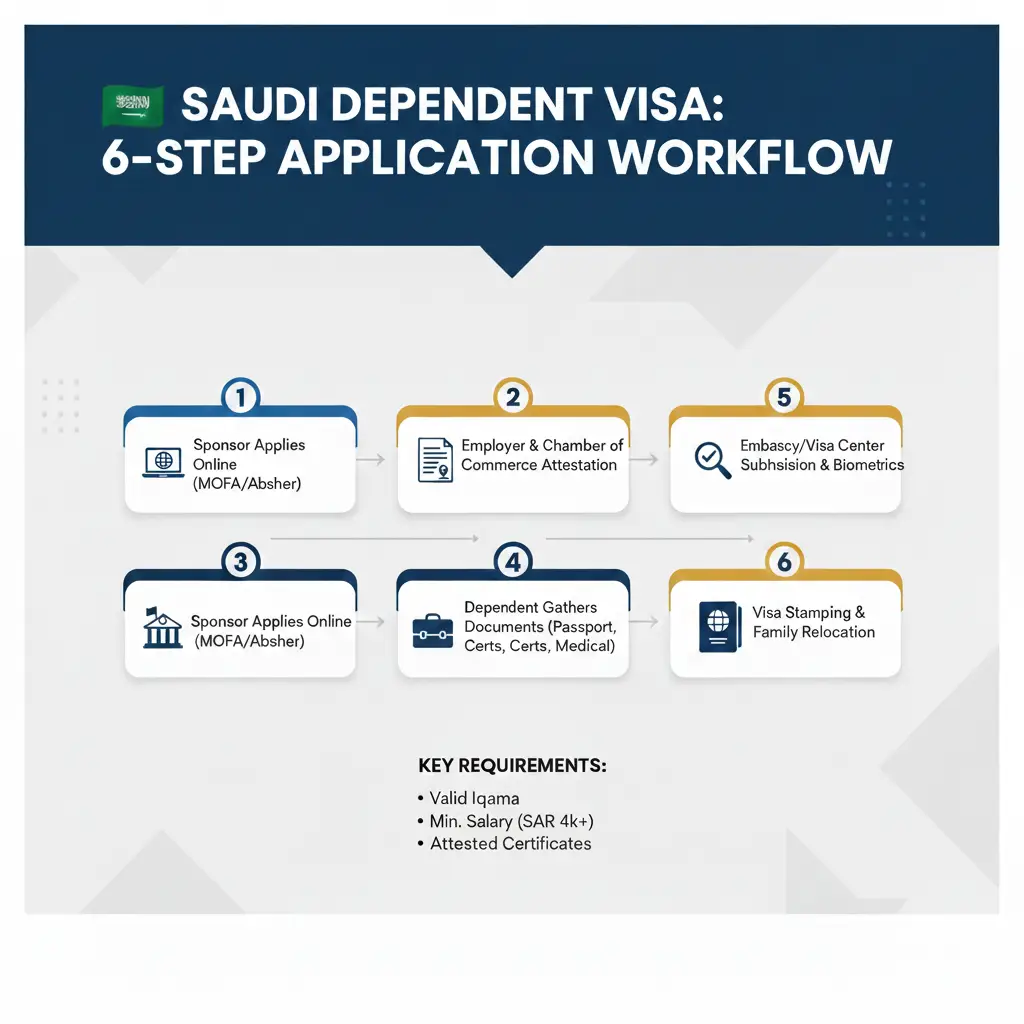
Before initiating the dependent visa process, the sponsor must meet several criteria established by the Ministry of Human Resources and Social Development (MHRSD):
A. Profession Category
Not all professions listed on an Iqama are eligible to sponsor a dependent visa. Generally, administrative, technical, and executive roles are eligible. “Labor” or “General Worker” categories may face restrictions.
B. Salary Threshold
To ensure the sponsor can support their family, a minimum salary is required. While this can vary based on updated regulations, the standard benchmark is typically a minimum salary of SAR 4,000. This must be reflected in the official employment contract registered with the GOSI (General Organization for Social Insurance).
C. Valid Work Iqama
The sponsor must possess a valid work Iqama. You cannot sponsor a dependent if you are currently on a relative/dependent visa yourself or if your Iqama has less than 6 months of validity.
3. Step 1: The Online Application (Sponsorship Stage)
The process of obtaining a dependent visa begins within Saudi Arabia. It is the sponsor’s responsibility to initiate the request through the official government portals.
The Digital Workflow:
-
Access the Platform: Log in to the Saudi Ministry of Foreign Affairs (MOFA) e-visa platform or your Absher account. Most family residency requests are handled via the “Family Visit Visa Application for Residents” or “Permanent Family Visa” section.
-
Submit the Request: Fill out the digital form accurately. The information provided must match the dependent’s passport exactly. Any discrepancy in the spelling of a name or passport number can lead to rejection at the embassy stage.
-
Company Approval & Attestation: Once the form is submitted online, it must be printed. The sponsor’s employer must sign and stamp the document. Crucially, it must then be attested by the Chamber of Commerce. Many companies handle this through their internal HR or PRO (Public Relations Officer) departments.
-
Tracking the Authorization: Monitor the MOFA portal. Once approved, you will receive a Visa Authorization Number. This number is the “key” that the dependent will use in their home country.
4. Step 2: Processing in the Home Country (Embassy Stage)
Once the authorization number is issued, the focus shifts to the dependent’s home country. The dependent must visit a Saudi Embassy or an authorized visa service center (such as VFS Tasheel).
Required Documentation Checklist:
-
Original Passport: Must be valid for at least 6 months and have at least two blank pages.
-
Recent Photographs: White background, as per Saudi visa standards.
-
Proof of Relationship: This is the most critical part. You must provide attested marriage certificates for spouses and birth certificates for children. These documents must be translated into Arabic and attested by:
-
The Ministry of Foreign Affairs in the home country.
-
The Saudi Embassy in the home country.
-
-
Medical Reports: Dependents (usually over the age of 12) must undergo a medical examination at a Saudi-approved clinic to receive a “Fit for Travel” health certificate.
-
Sponsor’s Documents: Copies of the sponsor’s Iqama, passport, and the attested employment contract.
5. Fees, Insurance, and Biometrics
The dependent visa involves several financial commitments that must be handled before the visa is stamped:
Visa Fees and Health Insurance
Payments are usually made via the Enjaz system or the authorized visa center. Mandatory health insurance is a requirement for all residents in KSA. The cost depends on the age and health status of the dependent.
Biometric Submission
The dependent must visit the visa center in person to provide fingerprints and facial recognition data. This is a mandatory step for the issuance of the residency permit.
6. The Dependent Fee (Expat Levy)
Since 2017, Saudi Arabia has implemented a monthly fee for each dependent living in the Kingdom. This is a crucial financial consideration for any expat considering a dependent visa.
-
Amount: The fee is currently SAR 400 per month per dependent.
-
Payment: This fee is usually paid in advance for the duration of the Iqama (e.g., if the Iqama is for 12 months, you must pay SAR 4,800 per dependent at the time of renewal).
-
Responsibility: While some premium employers cover this cost as part of their benefits package, in most cases, it is the responsibility of the employee.
7. Timeline and Common Challenges
Obtaining a dependent visa is a multi-step process that can take anywhere from 2 to 6 weeks, depending on the speed of attestations and embassy appointments.
Common Pitfalls:
-
Attestation Delays: Many applicants fail to realize that certificates must be attested by multiple government bodies. This should be started even before the sponsor applies online.
-
Incorrect Profession: If the sponsor’s Iqama profession is not eligible, the MOFA portal will automatically block the request.
-
Medical Rejection: Conditions such as certain communicable diseases can lead to a permanent rejection of the residency visa.
8. How Connect Resources Facilitates the Process
Navigating the dependent visa regulations can be overwhelming for busy professionals and HR departments. At Connect Resources, we provide end-to-end support to ensure your family joins you without unnecessary stress.
Our PRO and Visa Services include:
-
Document Attestation: We guide you through the global chain of attestation for marriage and birth certificates.
-
Application Management: We handle the MOFA and Absher submissions, ensuring 100% accuracy.
-
Saudization & Compliance: We ensure that the sponsoring company is in a “Green” or “Platinum” Nitaqat status, which is essential for visa approvals.
-
Expat Relocation Support: Beyond the visa, we help with the logistics of settling your family in the Kingdom.
9. Conclusion: A New Chapter in Saudi Arabia
The dependent visa is more than just a legal permit; it is the document that allows you to build a home and a life in the Kingdom. While the requirements are strict, they are designed to ensure that the family unit is supported and integrated into the Saudi social fabric.
By understanding the steps—from the initial MOFA application to the final biometric submission—and partnering with experts like Connect Resources, you can navigate the path to family residency with confidence.
Ready to bring your family to Saudi Arabia?
Don’t let bureaucracy stand in the way of your family’s future. Contact Connect Resources today for professional assistance with your dependent visa application and comprehensive PRO services.
[Contact Our Visa Specialists Today]
FAQ: Saudi Dependent Visa
Q1: Can I sponsor my dependent if I am on a temporary work visa? No. You must have a permanent work residency (Iqama) to be eligible to sponsor a dependent visa.
Q2: What is the age limit for sponsoring male children? Generally, male children can be sponsored until the age of 18. After 18, they may need to transition to their own student or work visa, although certain exceptions exist for students.
Q3: Does the dependent visa allow my spouse to work? No, a dependent visa does not automatically grant the right to work. If a spouse finds employment, they must undergo a “change of sponsorship” (Tanazul) to a work visa, provided the employer meets the necessary Saudization requirements.