
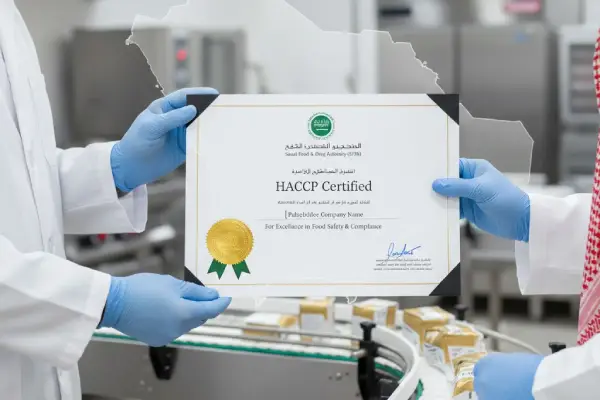
As Saudi Arabia continues its rapid economic diversification under Vision 2030, the food, hospitality, and catering sectors have seen unprecedented growth. With this expansion comes a heightened responsibility for safety and quality. For any business involved in the food supply chain, obtaining HACCP certification in Saudi Arabia is no longer just an option—it is a critical requirement for market access, legal compliance, and consumer trust.
At Connect Resources, we recognize that navigating the regulatory landscape of the Kingdom can be complex. This guide explores everything you need to know about HACCP certification, from its fundamental principles to the specific requirements set by Saudi authorities.
1. What is HACCP Certification?
HACCP stands for Hazard Analysis and Critical Control Points. It is an internationally recognized systematic approach to food safety that addresses biological, chemical, and physical hazards through prevention rather than finished product inspection.
The Meaning of HACCP
The core philosophy of HACCP certification is to identify potential food safety hazards before they occur. By establishing “Critical Control Points” (CCPs), businesses can implement monitoring procedures that ensure food remains safe at every stage—from raw material sourcing to processing, packaging, and distribution.
In the Kingdom, HACCP certification in Saudi Arabia is the benchmark for excellence, often required by the Saudi Food and Drug Authority (SFDA) for specific high-risk food sectors.
2. The 7 Principles of HACCP
To achieve HACCP certification, a business must demonstrate a deep integration of its seven core principles. These principles form the framework of a robust Food Safety Management System (FSMS).
-
Conduct a Hazard Analysis: Identify potential biological (bacteria), chemical (toxins), or physical (glass/metal) hazards.
-
Identify Critical Control Points (CCPs): Determine the points in the process where a hazard can be prevented or eliminated (e.g., cooking temperatures).
-
Establish Critical Limits: Set maximum or minimum values for each CCP (e.g., a minimum internal temperature of 75°C).
-
Establish Monitoring Procedures: Create a system to ensure each CCP stays within its limits.
-
Establish Corrective Actions: Define what happens if a limit is breached.
-
Establish Verification Procedures: Perform audits and tests to prove the system works.
-
Establish Record-Keeping: Maintain documentation of all processes and monitoring results.
3. Why HACCP Certification in Saudi Arabia is Essential
The Saudi market is governed by strict regulations designed to protect public health. The SFDA has increasingly made HACCP certification a mandatory prerequisite for various licenses.
Legal Compliance
Businesses such as food manufacturers, industrial caterers, and luxury hotels must comply with SFDA GSO standards. Failure to hold a valid HACCP certification can lead to heavy fines, shipment rejections at the border, or even the revocation of a commercial license.
Market Competitive Advantage
With the influx of international tourists and the growth of “Giga-projects” like NEOM and The Red Sea Project, hospitality standards have reached global levels. Holding an accredited HACCP certification in Saudi Arabia allows your business to:
-
Bid for high-value government and corporate catering contracts.
-
Export food products to other GCC countries more easily.
-
Build brand reputation and consumer confidence.
4. The Process of Obtaining HACCP Certification in KSA
Obtaining HACCP certification is a journey that involves internal preparation and external auditing. Here is the roadmap for businesses in Saudi Arabia:
Step 1: Gap Analysis
Evaluate your current facilities and processes against HACCP standards. Identify where your current Food Safety Management System falls short.
Step 2: Training the HACCP Team
Appoint a multidisciplinary team (Quality, Production, Engineering) and ensure they receive proper training on HACCP certification requirements. In KSA, it is common to seek specialized consultants to lead this training.
Step 3: Implementation
Develop the HACCP plan, including flow diagrams for every product and the documentation of monitoring procedures. Ensure that the facility meets “Prerequisite Programs” (PRPs) such as pest control, personal hygiene, and sanitation.
Step 4: Internal Audit
Before the external audit, conduct an internal review to ensure all corrective actions are documented and the staff is following the new protocols.
Step 5: External Certification Audit
An accredited third-party certification body will visit your facility. They will review your documentation and observe your operations in real-time. If you meet the standards, the HACCP certification is issued, usually valid for three years with annual surveillance audits.
5. HACCP vs. ISO 22000: Which One Do You Need?
A common question for businesses considering HACCP certification in Saudi Arabia is whether they should go for ISO 22000 instead.
| Feature | HACCP Certification | ISO 22000 |
| Scope | Focused strictly on food safety hazards. | Holistic management system (includes safety + business management). |
| Regulation | Often the minimum legal requirement by SFDA. | A higher-level international standard. |
| Structure | Based on the 7 Principles. | Based on the High-Level Structure (HLS) shared with ISO 9001. |
| Recommendation | Ideal for SMEs and specific food handlers. | Ideal for large manufacturers and international exporters. |
6. Common Challenges in Achieving HACCP Compliance
The path to HACCP certification in the Kingdom can be challenging due to environmental and logistical factors:
-
Temperature Control: Saudi Arabia’s extreme heat makes the “Cold Chain” a major Critical Control Point. Maintaining consistent temperatures during transport and storage is often the biggest hurdle.
-
Language Barriers: With a diverse expat workforce, ensuring that every kitchen worker or factory operator understands the HACCP logs and corrective actions is vital.
-
Documentation Burden: Many businesses struggle with the rigorous record-keeping required to pass a HACCP certification audit.
7. How Connect Resources Saudi Supports Your Compliance
At Connect Resources, we understand that your focus should be on your business growth, not on administrative bottlenecks. While we are known for our EOR and Recruitment services, we also assist companies in the food and hospitality sectors through:
-
Sourcing Certified Talent: We provide specialized Quality Assurance (QA) and Quality Control (QC) professionals who are experts in maintaining HACCP certification standards.
-
Government Relations (PRO): We help navigate the SFDA registration processes and ensure your business documentation is aligned with Saudi regulations.
-
Compliance Advisory: Ensuring that your workforce is fully compliant with the health and safety regulations of the Ministry of Human Resources and Social Development (MHRSD).
8. The Future of Food Safety in Saudi Arabia
By 2026, we expect the SFDA to further integrate digital monitoring into the HACCP certification in Saudi Arabia. Smart sensors and blockchain technology are beginning to play a role in tracking food safety from “farm to fork.” Investing in HACCP certification today is the first step toward future-proofing your business in an increasingly digitized and regulated market.
9. Conclusion: Investing in Quality
Obtaining HACCP certification is more than a regulatory box to tick; it is an investment in the longevity and integrity of your brand. In a country as dynamic as Saudi Arabia, being known for safety is a powerful asset.
By following the principles of HACCP certification, you ensure that your business contributes to the health and prosperity of the Kingdom, aligning perfectly with the national goals of excellence and modernization.
Ready to Ensure Your Business is Compliant?
Whether you are starting a new catering venture in Riyadh or expanding a food factory in Jeddah, Connect Resources is your partner for compliance and talent. Let us help you find the experts you need to manage your HACCP certification in Saudi Arabia.
[Contact Our Compliance Experts Today]
FAQ on HACCP in KSA
Q1: Is HACCP mandatory for all restaurants in Saudi Arabia?
While many municipal regulations require basic food safety training (Baladiya), formal HACCP certification is typically mandatory for hotels, food factories, and large-scale catering operations serving hospitals or airlines.
Q2: How much does HACCP certification cost in Saudi Arabia?
The cost varies based on the size of the facility and the number of food categories. Generally, it includes consultant fees for setup and the auditor’s fees for the certification itself.
Q3: Can Connect Resources help with the physical audit?
We provide the human capital (Managers and Auditors) needed to prepare and maintain the system, while the physical audit must be conducted by an accredited certification body.